


| Graptolite Net | Graptolites & Graptoliters | Cephalodiscoidea | Rhabdopleuroidea | Crustoidea | Camaroidea | Tuboidea | Dendroidea |
| Graptolite Net is edited and periodically updated by Piotr Mierzejewski, the Count of Calmont & Countess Maja Korwin-Kossakowska since 2002 Sponsored by Artistic Embroidery M.M. plus M. Sztandary Fahne Flags |
| GRAPTOLITHOIDEA: Cephalodiscoidea |

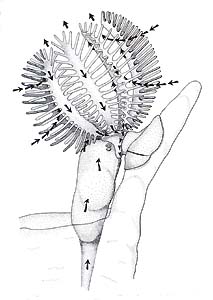
| Cephalodiscus: Ciliary currents of zooid |
When feeding, a zooid of Cephalodiscus is perched at the mouth of
the tube or out on one of the spines, using the cephalic shield as an
adhesive disc. All its arms are arched to form a basket.The picture
shows ciliary currents of Cephalodiscus zooid. Curved arrows indicate
water moving toward arms and tentacles and into rejection current.
Upward-pointing arrows represent rejection current in center of
lophophore. Arrowheads show food canal behind oral lamella. Arrows
on trunk and stalk indicate patterns of particle movement on ciliated
epidermis.
The methods of water movement and particle clearence during feeding
in Cephalodiscus similarly occur in bryozoans, phoronids,
brachiopods, and other pterobranchs.
Source:
Lester, S.M. 1985. Cephalodiscus sp. (Hemichordata: Pterobranchia): Observations of functional
morphology, behaviour and occurence in shallow water around Bermuda. - Marine Biology 85, 263-268.
the tube or out on one of the spines, using the cephalic shield as an
adhesive disc. All its arms are arched to form a basket.The picture
shows ciliary currents of Cephalodiscus zooid. Curved arrows indicate
water moving toward arms and tentacles and into rejection current.
Upward-pointing arrows represent rejection current in center of
lophophore. Arrowheads show food canal behind oral lamella. Arrows
on trunk and stalk indicate patterns of particle movement on ciliated
epidermis.
The methods of water movement and particle clearence during feeding
in Cephalodiscus similarly occur in bryozoans, phoronids,
brachiopods, and other pterobranchs.
Source:
Lester, S.M. 1985. Cephalodiscus sp. (Hemichordata: Pterobranchia): Observations of functional
morphology, behaviour and occurence in shallow water around Bermuda. - Marine Biology 85, 263-268.
| SCIENTIFIC PORTAL FOR USERS INTERESTED IN PTEROBRANCHS AND GRAPTOLITES |

